TEN TALKS TO CLAUD
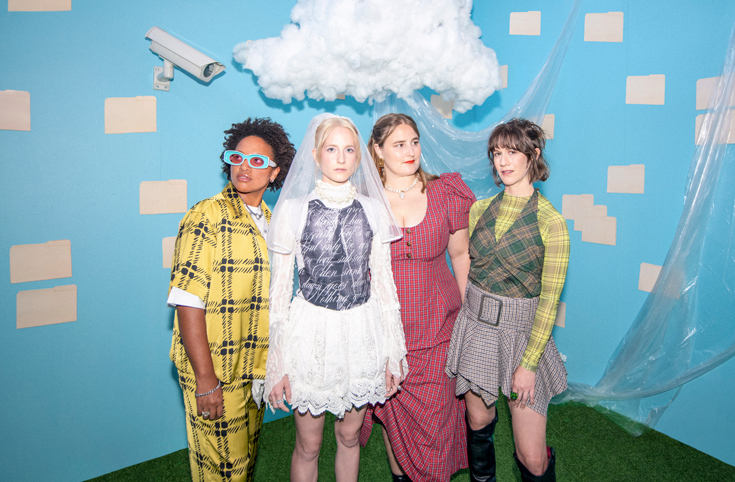
Claud has returned with their third studio album, Me and the Music. The Chicago-raised, Brooklyn-based artist worked alongside acclaimed producer John Congleton, who took a more hands-on role in shaping the record. Exploring the question, “Does everything have to feel so heavy all the time?”, the album marks a shift in perspective for Claud.
“I was just sick of taking everything so seriously – Supermodels was such a serious record, and I just sulked in feelings for so long... Such terrible things have happened in this country the last few years, but I’ve only grown closer to the people around me because of that. The world has shown me that the worst can happen, but it might just bring you closer to your community. There’s a difference between being sincere with life and taking life too seriously.”
We caught up with Claud to discuss working alongside Congleton and the creative process behind Me and the Music:
The album is great. I've loved your music from the beginning, so it’s cool to hear the evolution. Tell me about your headspace and mindset going into making this record, and what had shifted for you by your third album.
That’s awesome that you’ve been listening to my music for a long time. Thank you. That’s super cool.
With this album, I focused a lot on songwriting and storytelling. I didn’t even think about how I wanted the record to sound until after I wrote it, which is usually something I do at the same time. With the past two records, I wrote the songs around the production and the sound. But this time I thought, “I’m going to write the best songs I can possibly write, and then I’ll think about the arrangements and production later.” So that was probably the biggest shift.
Where did you write it? Is your environment important to you when you’re writing a record?
It depends on the day, but yes. Sometimes I really need to get out of the house. I was really lucky and wrote some of the record at Electric Lady, which is just awesome. I can’t believe I get to say that.
It was nice to get out of the house, work, and then come home. Sometimes I need to get out of New York altogether and go on writing trips. I wrote in LA a little bit, but most of the time I’m writing in my living room.
And do you feel like that’s where you can be most yourself?
I think so, yeah. I definitely write my weirdest, best songs when I’m just sitting on my couch, it’s really late at night, and I’m watching TV or something. Sometimes I write music while I’m watching TV, which is crazy. Just a show I’ve seen a million times. I need background noise.
What are the shows?
I’ve watched a lot of Parks and Recreation. That’s a background noise show for me. Stuff like that. I love comedies and rom-coms.
I want to talk about working with John Congleton, who’s been working on some of my favourite music released this year. How does he help shape your sound?
Working with him was such a different experience from anyone I’ve really worked with before. We had a few meetings before we started recording. We recorded over a two-week period, which is pretty short, but all the songs were already written and there were only 10 of them, so it made sense for this record.
Beforehand, we had a bunch of meetings where we talked about references. I actually made a playlist, song for song. I wanted "Gay Witchcraft" to sound like this, and "The Legend" to sound like that. Each song had one to three references, and he was just like, "Yeah, great. We can do that." There's no "we can't do that" with him.
He really is an anything's-possible kind of guy, and it's because he's just so professional. He's been making records forever, and he makes a million records a year. Not really, but he's just so seasoned and music-literate. It's crazy.
Is it hard for you to figure out who you want to work with, producer-wise? I feel like I'd be so overwhelmed.
Yeah, it is. It's super hard. That was the biggest challenge. But actually, when I finished Supermodels, a few weeks before it came out, Congleton had reached out to me and said, "I really want to do a record with you." And I was like, "I just finished one, so this is bad timing."
He said, "Whenever you're ready, I really want to do a record with you."
Then we tried it. We actually did a trial day together, and we made "The Reach". It became my favourite song I'd ever made, and I was just like, "Yeah, this is a no-brainer." I got lucky, but I think most of the time it's really hard.
Which song was the biggest challenge for you?
"Me and the Music" for sure. It was so hard to write because I didn't understand it. It was the first half-kidding, half-serious song I think I'd made in a while. It was like, this is hilarious and silly, but also, why am I crying? That was a complicated feeling to understand.
Writing it was a banging-my-head-against-the-wall experience of, "Ugh, that's not the chorus, that's not the chorus." Producing it was the same thing. I think we went through three or four different versions of it, and the version that ended up on the record is the first version we even tried.
So it ended up coming full circle, but I just felt like we couldn't get it right.
Then John actually sent me the instrumental instead of the version with my scratch vocals, and I was like, "Oh, the instrumental is perfect. This is the version." That's how we came to it.
Cool. I also really love the visuals. I love the artwork. I even love the website. Tell me about what inspired the visual world for this album.
Leo Horton did the album cover and all the vinyl inserts and CDs, all the physical artwork too. He's amazing.
I originally found out about his work through my band Shelly. He did merch for us, and he did such a good job. He also does Claire's merch, and I was like, "I love your art so much. I want you to do my album art."
I've actually never met him in person. We've only texted. I don't think we've ever even talked on the phone, which is crazy. Our text chain is unbelievably long. We text like we're best friends, but we've never met.
Are you voice-noting?
We're not even voice-noting, no. We're just sending paragraphs back and forth and screenshots. Anytime I see a piece of art I like, I just send him a picture of it.
We have such similar taste. We talked for a couple of weeks about what I wanted the artwork to look like, and I sent him a million Pinterest boards.
At the time, I was going to a lot of record stores. When I'm trying to find artwork, I like to go through the bins and look for inspiration. I also look through a lot of magazines, art books and stuff like that. I was just sending him a ton of pictures, and he really got it.
From what I've read and seen, it seems like you've found really good mentors in the industry, like Phoebe Bridgers and Jack Antonoff. You've been doing it for a while now, and you work with other artists. I love what you've done with Romy Mars. Which other artists are you feeling excited about now? Who's inspiring you?
I'm really excited about this one artist, Wesley Preis. She's from San Diego. She only has a few songs out, and I think my partner said she's like if Fiona Apple and Lucy Dacus had a baby. Her voice is unbelievable. Her song "Figures" is incredible. I'm obsessed with it. I also write with my friend Hank Heaven, who has an artist project called Hank Heaven. They're incredible. They're my favourite songwriter ever. Those are two artists I'm really excited about.
How does it work with you? Are you approaching the artists you want to write with, or are they approaching you most of the time?
I'm usually approaching them. Once in a while, people reach out to me for sure, but if there's somebody I really want to work with, I can't help it. I'm on the DMs. I'm like, "Hi." I'm like, "Why don't we make it work?"
I'm very intrigued to ask this because you write great pop songs. Has your idea of what makes a great pop song shifted throughout your career?
Yeah, definitely. In high school, I was obsessed with songwriting. I would go to songwriting conferences and make my mum take me to anything songwriting-related. I would sit in a room of hundreds of people and listen to songwriters talk about songwriting.
One time, I even made my mum drive to Nashville with me from Chicago. I learned a lot in high school about country song structure. I wasn't writing country music, but I was obsessed with it. I thought that's just what songwriting was, and I learned it through a country-writing lens, which is very structure-focused. It's a 10-second-or-less intro, verse, pre-chorus, chorus, verse, pre-chorus, chorus, bridge. It's very formula-driven.
Then, when I got to college at 18, I was introduced to indie rock, and I was like, "Oh, this is much cooler and much better."
I feel like pop music lands perfectly in the middle of country and alternative music. The structure can follow a perfect formula and the song can be the best song you've ever heard, or the structure can follow no formula at all and it can still be the best pop song you've ever heard.
Pop music is one of my favourite genres to write in. There's just so much you can do.
Listen to Claud's new album HERE.