TONY MARCUS ON What Makes A Perfume Preppy
There isn’t much about perfume in The Great Gatsby or The Talented Mr Ripley but there is plenty about the comfort of money. And the preppy style of old American money. Do you know the score? Riding boots, cocktails, a man’s rings, his wealthy father, tennis, parties with Hollywood stars and the luxury of travel to the great hotels of Rome, Venice and San Remo in the years before mass tourism.
I like detective work. I knew that if I was looking for ‘preppy’ I should read Patricia Highsmith’s The Talented Mr Ripley. I’ve seen all the films. The beautiful one with Alain Delon, the sassy Gwyneth one with Matt Damon, and Wim Wenders’ gritty Hamburg flick with Dennis Hopper. The Talented Mr Ripley was the first book in the series, published in 1955, and it was, as I anticipated, a good primer for preppy culture. There is plenty of material about trust funds and suits. The book was less hetero than I expected. The young Ripley knows a homosexual milieu among the interior designers of New York. And the book is fetishistic. Especially about gloves. And clothes. And ties and wallets. Highsmith is very good on just how much Ripley loves the kind of clothes that only old money can own or buy.
“The cufflinks, the white silk shirts, even the old clothes – the worn brown belt with the brass buckle, the old brown grain-leather shoes, the kind advertised in Punch as lasting a lifetime, the old mustard-coloured sweater with the sagging pockets, they were all his and he loved them all. And the black wallet, a well-worn alligator wallet from Gucci’s.”
Ripley had to kill for that stuff. He had to kill a man to take his shoes. And what Tom Ripley and Jay Gatsby have in common is they are both outsiders. Ripley is a murderer and F. Scott Fitzgerald at least suggests that Gatsby, in his gangster mode, may have killed. Neither of these characters were born rich. They have to go out and take it. In the Ripley stories he befriends a young man, Dickie, from an old, wealthy family. Kills him and steals his identity. And his wardrobe. In Paris, in a good hotel not long after the murder, Tom Ripley touches the dead man’s jackets, shirts and ties. He holds them “affectionately”, notes Highsmith.
“When he spent evenings alone, handling Dickie’s possessions, simply looking at his rings on his own fingers, or his woollen ties or his black alligator wallet, was that experiencing or anticipation?”
Ripley spends quite a few nights enjoying himself with the shirts and blazers. His great love is the comfort of wealth. Also a little elegance. He likes good wine, art, hotels, books, travel… So I wanted to find a perfume that offered what Ripley craved. And I knew the parfum of Bleu de Chanel, the more recent Exclusif release, was perfect. It has a signature I recognise from Bleu. It has a feeling of the earth and is fresh, almost moist. Like an imagined forest. But the Exclusif has a more delicate (to my senses) ending that is aesthetically beautiful. It is transparent, vaporous and sensual. Ripley would understand. The Ripley who made a sketch from a Guido Reni painting in Palermo… he would love this. The Ripley who bought a two-volume edition of Malraux’s La Psychologie de l’Art to read, of an evening, in his Venetian palazzo. He would know.
The perfume maintains Chanel’s reputation for using expensive ingredients. Cheap is Tom Ripley’s nightmare. He is worried he will have to return to his old life and old clothes. This is a near constant theme in the book; he is scared of getting caught for murder but more scared of returning to poverty and having to wear “a shabby suit of clothes”. There is nothing that feels cheap in this perfume. The Exclusif Bleu, says Chanel’s nose Olivier Polge, offers a “concentrate of exceptional raw materials”. I asked if he could explain further.
“To be specific, the main exceptional raw materials consist of sandalwood, cedarwood, cistus labdanum – which is an aromatic resin from rockrose that adds depth and sensuality – and amber.”
And that long, poetic ending of the Exclusif Bleu. What is in that? Because it’s fragile, shimmering. It almost announces itself as ‘beautiful’.
“The base of Bleu L’Exclusif is a new sandalwood developed exclusively by Chanel – New Caledonian – which during extraction isn’t heated as much as other varieties, releasing a warmer scent,” says Polge.
There is a scene in Gatsby where he shows Daisy (his great love) his shirts. So many shirts. There are sheer linen and thick silk shirts. Fine flannel shirts. They come pouring out of his wardrobe. Shirts with stripes and plaids, shirts in coral and “apple green” and in “faint orange with monograms of Indian blue”. They are so beautiful they make Daisy cry. And I don’t know if she is crying for love or crying because she is a demented materialist, but the shirts make her cry.
“Suddenly with a strained sound Daisy bent her head into the shirts and began to cry stormily. ‘They’re such beautiful shirts,’ she sobs, her voice muffled in the thick folds. ‘It makes me sad because I’ve never seen such – such beautiful shirts before.’”
Now, while it has been years since I watched Delon as Ripley in Plein soleil (Purple Noon), I want to watch it again and look at how materialism is presented in the film. These films and books seem to know a set of signs and symbols and move them around to tell us something. I guess you have to belong to really understand. I don’t. Anyway, for years Dior used Delon as the face of Eau Sauvage. The Delon picture is not an image of Ripley; they use a still from another 1960s film, La piscine. But it’s the same actor. Same period. And the same corrupt and distant feeling.
Eau Sauvage was created by Edmond Roudnitska in 1966. This is not the contemporary Sauvage. This is the old perfume. It is a scent of transparent nature. Of lemon softened with green notes. And the right amount of dark jasmine or tangy moss to create a sensual edge. I used to think, “Oh, that is a musk”, but that addictive, animalic note may come from moss and jasmine. Either way, it smoulders. Dior must know Eau Sauvage doesn’t quite belong in the modern world. It is more encoded and discrete. Nothing is too loud or screamingly obvious. Can you read the shirt? Do you know the tie? And there is a moment in the 1999 movie where his brogues are ‘read’. I also tried Van Cleef & Arpels’ Encens Précieux, which has a burned, woody accord for the grand hotels and the libraries of Ivy League universities. But interestingly, if we are spotting trends, the Van Cleef is a modern perfume and there is a vast amount of vanilla in it. More than I expected. That vanilla leads to a very delicate close. Like the Exclusif Chanel, it wraps us in beauty.
I am sure masculines used to be harsher. It reminds me of a story in Edie Sedgwick’s biography. Her family were ultra-preppy old American money. And one of her brothers had asked how to make love (to a woman). How to be good in bed. The answer? Love. Just love. Show your love for another person and their body. Keep it that simple.
I don’t believe that sentiment is the exclusive preserve of old money, but instead a peaceful sort of masculinity closes these perfumes. Harsher notes have been pushed into the shadows. And this elegance is the perfume of old money and power. But perhaps I am only imagining this. Like Tom Ripley and Jay Gatsby, I dream about what has never been mine. I am not sure I wholly approve but… it smells beautiful.
Notes
Edie: An American Biography (1982) by Jean Stein
The Talented Mr Ripley (1955) by Patricia Highsmith
The Great Gatsby (1925) by F. Scott Fitzgerald
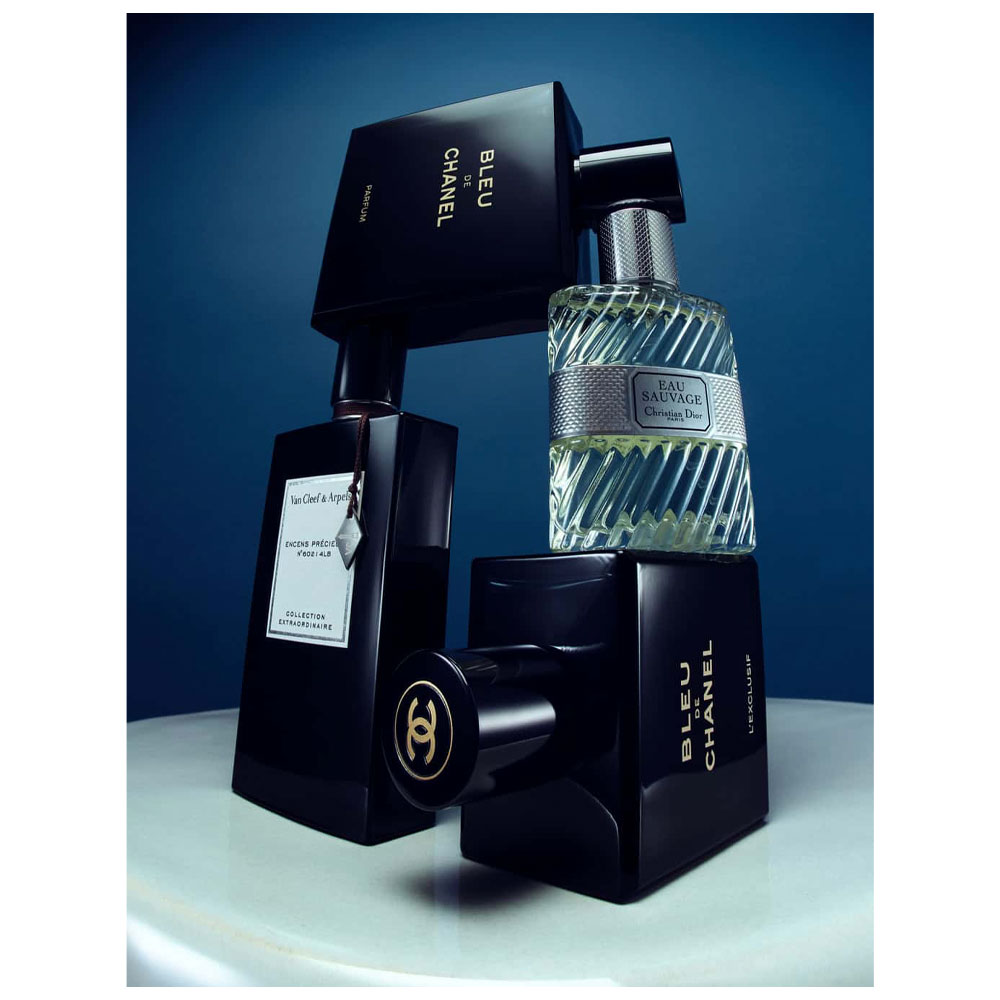
Top image: Clockwise, from top left: Bleu De Chanel Eau de Toilette by CHANEL, Eau Sauvage Eau de Toilette by DIOR, Bleu de Chanel L’Exclusif parfum by CHANEL, Collection Extraordinaire Encens Précieux Eau de Parfum by VAN CLEEF & ARPELS
Photography by Rikki Ward, with fashion assistance by Georgia Edwards. Taken from 10 Men Issue 27 – CLASSIC, CRAFT, NOSTALGIA – out NOW.