THE ILLUSIONIST: SAMUEL LEWIS
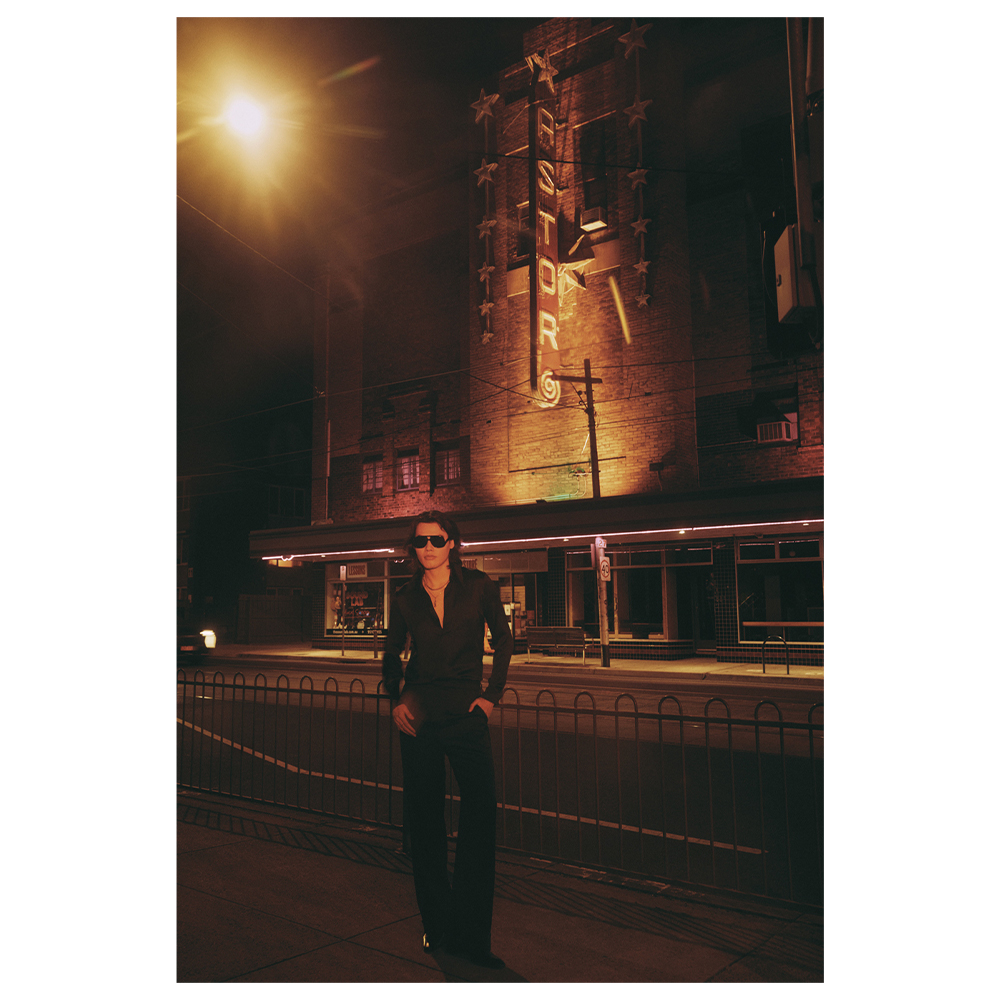
We need super creators, and Samuel Lewis is one of them. But then, for Lewis, fashion was always his destiny. “It’s the first job I ever wanted to do, something that’s been ingrained in me since I was young.” His mother had great style and so he developed his eye and taste from a young age inspired by her “amazing wardrobe and how she wore it”.
Importantly, when he was a child, Lewis’s mother taught him how to draw fashion figures by tracing over magazines. “One of the main reasons I chose to pursue fashion in the end was because it was the truest wish I had deep down from when I was a kid. Choosing that path was choosing the first thing I ever fell in love with, so it all came full circle for me.”
He describes his mother as “an extremely elegant woman”. They love shopping together and vintage is their shared passion. “We’re each other’s devil’s advocate. Whenever I don’t know if I should buy something, she always says, ‘Just buy it, you only live once!’” Vintage and an appreciation of historical dress have been part of Lewis finding his own personal design DNA. But when it comes to designers now, he confides, “l have been known to love an Anthony Vaccarello for Saint Laurent moment! I like that kind of dark vampire energy.” We agree that we loved the Saint Laurent SS26 RTW collection, especially those final, swaggering lightweight gowns. “I like the idea of using a technical fabric in an eveningwear setting. And I thought it was genius the way it was presented with the flowing windswept dresses. I was obsessed with it,” he says. When he was a student at the Polimoda fashion school in Florence, everyone wore vintage. “At the beginning, we were all figuring out our personal style and we came in a hodgepodge, a mess of different eras mashed together. I love that.”
Lewis was born in Canberra, but says he “was raised all over the world. My dad worked for the Australian Embassy, so I was born here, but then I moved around to Vietnam, New Zealand, India, Vienna… I’ve lived in a million countries.” Before landing in Florence, he split his high schooling between Canberra and Vienna. “I knew that Europe was the place for fashion so I took that experience while I could.” The four-year BA course, from which he graduated in 2022, gave him a solid grounding. “It was well-rounded, we all did everything. One the best things about my experience, though, were the other students who were super international. They helped me broaden my horizons of what was possible and hear different points of view about what fashion could mean to different people.”
The teachers, too, were wise. “They were older women who had worked at Italian companies for a very long time and all came with this savoir faire that was impossible to learn anywhere else. They were always willing to help. I remember trying to make the most insane, larger-than-life gowns and I’d have no idea how to construct them. They would always figure something out and say, ‘Wait until tomorrow and we’ll do it together.’”
Living in Florence slaked his thirst for history and art. “One of my favourite places is the Stibbert Museum there. While I was preparing my final collection I was so inspired by the historical portraiture and armour.” Film is also an important reference for Lewis and his go-to movies include 1957’s Funny Face, directed by Stanley Donen. “I’ve been obsessed with it for a number of years. Specifically, I love to watch the montage of Audrey [Hepburn] doing her different photographs around Paris. It touches on all the things I love in fashion and that era because of the focal points of the human body: a narrow waist line and how they liked to accentuate the shoulder and décolletage area. There was a larger-than-life volume in the ballgowns, skirts and tea-length dresses. In the film, that specific montage goes through this whole array of genres of dressing that I found so flattering to the body.”
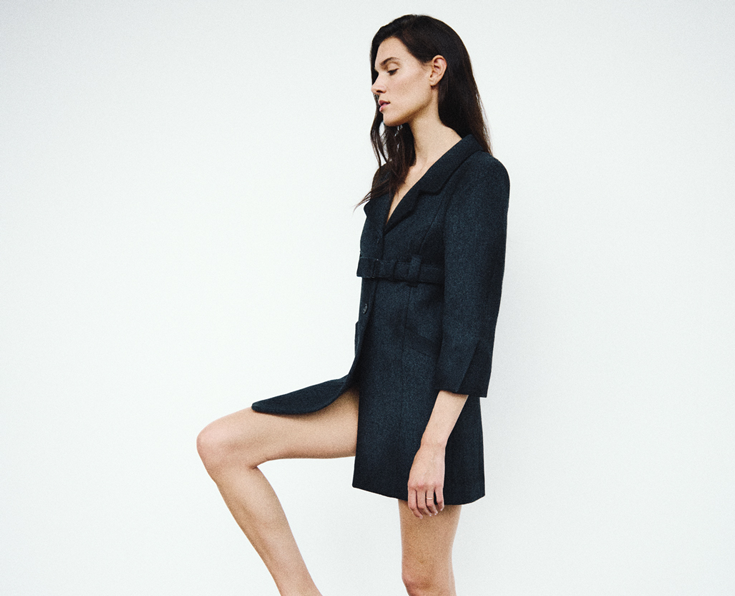
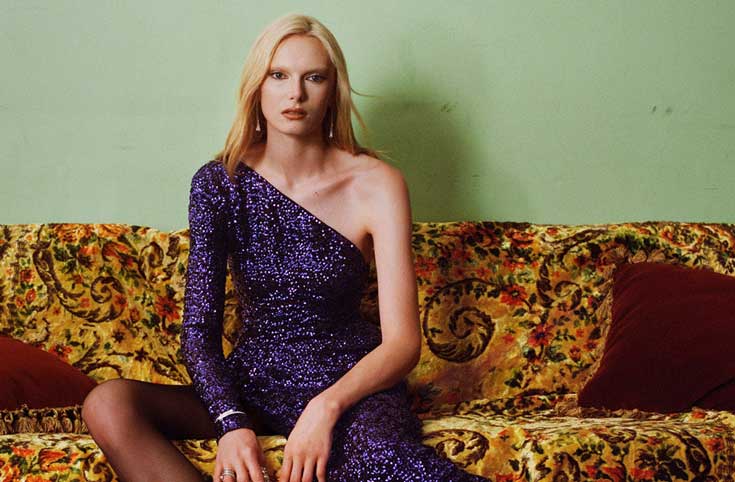
The secret to his success is that Lewis flatters a woman’s body. “It’s an intuitive thing – I tend to always lean towards this super-cinched waist with more volume on the bottom half.” Of course, there are exceptions to the rule. “I’m always trying to snap myself out of that at the same time. It’s a tightrope I’m walking of consistently bringing the same silhouettes, but also not always staying in the comfort zone of what I like.”
He particularly loved all the historical artworks in Florence. “There’s something almost gothic and a little bit melancholy about it that I find [makes me feel] a little bit uneasy, but also that draws me in.” He likes the darkness. One specific portrait of Catherine de Medici resonated. “In many of her portraits she’s dressed in black, as she was in mourning for her husband and children. I became obsessed with one; in it she’s painted in a very high collared black jacket and I think the main signifier of that jacket has been carried on a lot in my work recently, especially with Gaga. It’s like the birthplace of that specific silhouette.”
Before creating three epic costumes for Lady Gaga’s The Mayhem Ball tour, he was a big fan and so it was, he shares, “a huge moment for me to be able to work with her”. Pressed to pick a favourite record he chooses 2009’s The Fame Monster as his “total Gaga era”. The tour commission came via Nick Royal and Peri Rosenzweig, stylists and designers he had worked with on a custom piece previously. “I was in Thailand, in full holiday mode, and got a text saying, ‘We’re doing a video and wanted to see if you’d be interested in sketching some things for it,’” he remembers. And so it began, “the whole process of being asked to start to design and then be in the discussions around the looks was everything I ever wanted.” He worked on two videos, Disease and Abracadabra, her 2025 Grammy’s look and then Coachella, which led into the tour. “I had worked with Nick and Peri before, right after graduating, but I had never met them in person. After this whole Gaga thing happened, they were a catalyst in continuously bringing me on and believing in my work. The three of us found an amazing symbiotic relationship in the way we came up with ideas together and the designs I made would have been impossible without their input. They were so hands-on about the image they were trying to create for her. And then also Parris Goebel, who choreographs and art directs for Gaga. She’s great and was so present in the whole process of the creative vision.” When he watches the videos of it now, he says, “I’m like, wow! We really didn’t know just how big that would be. It’s so surreal. It’s incredible as she comes out at the beginning.”
Gaga’s opening costume, the Elizabethan-esque red velvet cage dress and all it conceals and reveals, is undeniably engineered epic theatre, capturing all the swaggering dystopia that the show promises. “It’s been amazing to get to know her,” he says, “and for her to be as wonderful as you thought she’d be. She’s just so driven to perform no matter what, so she’s going to do something amazing on stage.”
Well-deserved recognition has come early in his career but the hardest part, he says, is “being your own boss and wanting to execute a vision, but then also having to be the captain of the ship. It’s always a bit of a thing. I’m quite level-headed most of the time, so my mistakes are usually not terrible.” In a tough industry he is an optimist, which helps. “I get that from my friends and my family so I’m often the pick-me-up person, I push people forward rather than bring us down.” He is a spiritual, thoughtful person, something that he says comes from his mum, as she has “a trust of the universal energy – and gratitude as well. My mum has always been a big advocate for gratitude and everything else will follow.” Lewis’s number one fans are his parents. “They have been the ones to put their own needs aside and say ‘follow your dreams’, and then for the success to come afterwards has been a wonderful gift. It proves that if you support and believe in your child they can achieve what they want.” His older sister Jacqueline is a freelance stylist and photographer. “She has been my best friend my whole life,” he says.
The dream for 2026 is to do a collection. “I want to be able to create a full storyline from start to finish of what my vision is. I’ve been existing in this demi couture space where a lot of my work has been through private or celebrity clients. I do have a true love for that, and I have a love for bespoke creation and how that all works. But I’ve always wanted to be able to explore what it would mean for my clothes to be worn by ‘real’ people.” Lewis is currently working on a collection that he plans to release this year. He would like to show in Paris. “I lived there for a year and I would love to be able to show on calendar, but at the moment I’m more concerned about making sure the clothes are the best they can be.”
Being appointed to a house is also part of the dream. It’s “definitely something that I’ve always wanted,” he says. He grew up loving Galliano and McQueen and appreciates how they managed to have their own visions and were able to translate that to the houses they worked within. “That’s a big dream for a lot of designers, to have that amount of resources and global reach.”
Lewis has also always had a “soft spot” for Givenchy. “I feel like there’s my love of Funny Face [Hepburn wears Givenchy dresses in the film] and my leaning towards the darker and more mysterious. I had such a love for Cristobal Balenciaga’s work from the meticulous clean lines and the elegance he had in his work. And then the way [Hubert de] Givenchy was his protégé and took on the same elements he was working with and reinvented them into a new, even more hyper-feminine silhouette. This is something people often overlook. I love it for the reasons of the Galliano, McQueen and Riccardo Tisci eras. They all brought this different, dark side to Givenchy, which technically isn’t even part of the brand’s DNA, but because of their impact now it is. I feel like the merging of both of those worlds could still happen.”
When he is designing, “sometimes it’s not always on the nose or not always easily recognisable from what it is in the beginning,” he says, “but I think that I try to exist in that space of illusion dressing. I love that. And I feel like it’s the vibe of what I want to continue doing.”
Taken from 10 Magazine Australia Issue 27 - CREATIVITY, FREEDOM, CHANGE - out now.